A year ago, the customer feedback problem was obvious: product teams had more conversations than they could read. Today, an AI system can summarize a quarter of calls, tickets, and interview notes before the first planning meeting of the day.
That sounds like the problem is solved. It is not.
The constraint has moved. When synthesis becomes instant, the scarce skill is no longer producing a summary. It is deciding whether the summary deserves to influence a roadmap.
Product teams now need to answer a harder question: Can we trace this conclusion back to independent, current, decision-relevant evidence?
Customer synthesis crossed the cost threshold
The economics changed quickly. The Stanford 2025 AI Index found that the inference cost of a system performing at GPT-3.5 level fell more than 280-fold between November 2022 and October 2024. Summarizing another hundred transcripts is no longer a meaningful budget decision for many software teams.
Adoption followed. In McKinsey's 2025 global AI survey, 88% of respondents said their organizations regularly used AI in at least one business function. Sixty-two percent said their organizations were at least experimenting with AI agents.
Product development sits directly in that shift. Research, support, sales, and product teams are all generating machine-assisted notes, classifications, summaries, and recommendations. The volume of interpreted customer data is growing faster than the number of people available to inspect it.
A summary and an evidence system are different artifacts
A summary is compression. It removes detail so a person can understand a large body of material quickly.
An evidence system supports a decision. It must preserve enough detail to test a claim, inspect disagreement, understand scope, and return to the source when the stakes rise.
Those are different jobs.
Imagine an AI review of 50 conversations produces this finding:
Customers are asking for better export controls.
It sounds useful. But the underlying distribution might tell three different stories:
- 38 mentions came from free users trying to avoid a plan limit.
- 9 came from one enterprise account repeating a compliance requirement across channels.
- 3 came from churned customers who needed scheduled exports, not more controls.
The sentence is not necessarily false. It is too compressed to guide a decision. Frequency, account independence, segment, intent, and requested outcome all changed during summarization.
| A summary answers | An evidence system also answers |
|---|---|
| What themes appeared? | Which sources support each theme? |
| What was mentioned most? | How many independent customers mentioned it? |
| What seems important? | Important to which segment, during what period, and why? |
| What should we consider? | What evidence contradicts the recommendation? |
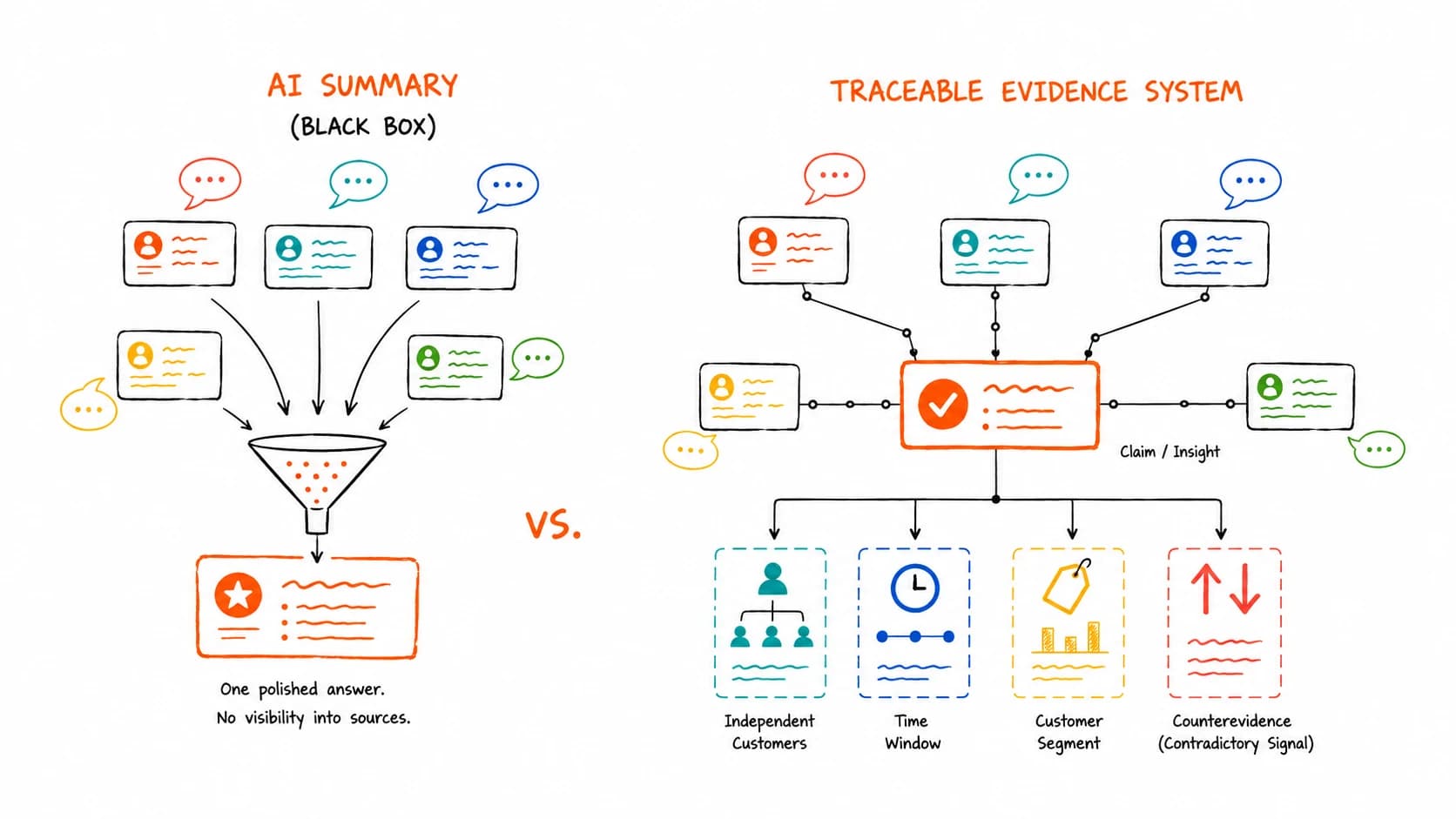
The more polished the summary, the easier it is to overlook these missing questions.
Five failure modes appear when synthesis gets cheap
1. Repeated voices masquerade as broad demand
Message count is not customer count. One urgent account can generate a support ticket, three Slack escalations, a call transcript, and a CRM note about the same incident. A naive clustering system sees six signals. A product leader should see one customer, one event, and several observations.
Before ranking a pattern, deduplicate by account, incident, and underlying outcome. Keep repetition as a measure of intensity, but do not confuse it with market breadth.
2. Contradictions disappear into the average
Generative summaries are good at producing a coherent center. Product strategy often depends on the edges.
Ten customers may want more configuration while four say setup is already too complex. The minority is not noise. It may represent the segment you are trying to grow, the usability cost of the majority request, or an early warning that two jobs are being forced into one workflow.
Ask the system to surface disagreement explicitly. A useful synthesis should show the dominant pattern, credible counterevidence, and the segments behind both.
3. Recency looks like momentum
A burst of mentions after a release may reflect a temporary defect, a documentation gap, or a genuine change in customer expectations. A single time window cannot tell you which.
Every material claim needs a time boundary and a baseline. Compare this period with the previous one. Separate newly emerging issues from persistent ones. Note product releases, pricing changes, or incidents that could explain the movement.
4. Synthetic notes start citing synthetic notes
An account manager uses AI to summarize a call. A CRM assistant summarizes the account record. A product tool ingests both and treats them as independent evidence. The final recommendation appears well supported, but every path leads back to one conversation and two layers of interpretation.
This is circular evidence. Preserve source lineage so a generated note is marked as a derivative, not counted as a new customer observation.
5. The recommendation outruns the evidence
Customer evidence can establish that a problem exists. It rarely proves which solution should be built.
"Users cannot reconcile invoices" is evidence about an outcome. "Build a reconciliation dashboard" is a solution hypothesis. Keeping those statements separate prevents a fluent model, or an enthusiastic team, from turning the first requested feature into the assumed answer.
Give every important claim an evidence contract
Teams do not need to manually reread every source. They need a minimum standard that lets reviewers inspect the claims that carry a decision.
For each claim entering prioritization, capture this evidence contract:
| Field | Question to answer |
|---|---|
| Claim | What do we believe is happening? |
| Source links | Where can a reviewer inspect the original observations? |
| Independence | How many distinct customers, accounts, or events support it? |
| Scope | Which segment, workflow, plan, region, or product area does it affect? |
| Time window | When did the evidence occur, and is the pattern changing? |
| Counterevidence | What credible observations do not fit the claim? |
| Confidence | What is known, inferred, and still missing? |
| Decision link | Which bet, experiment, or roadmap choice uses this claim? |
This is not documentation for its own sake. It is a compact interface between machine synthesis and human judgment.
The contract also creates a useful stopping rule. If a claim has no independent sources, no defined scope, or no path back to the original material, it can still be a discovery lead. It should not yet be treated as roadmap evidence.
Redesign the workflow around traceability
Adding citations to the final paragraph is not enough. Traceability has to survive the whole path from source to decision.
1. Preserve the raw observation
Keep the original ticket, quote, transcript segment, or behavioral event available. Record who or what produced any summary derived from it.
2. Separate observation, interpretation, and recommendation
Use three explicit layers:
- Observation: what happened or what the customer said
- Interpretation: the problem or pattern the team believes it represents
- Recommendation: the action the team might take
Each layer introduces judgment. Labeling them makes that judgment reviewable.
3. Retrieve before synthesizing
Build conclusions from a bounded source set, then cite the supporting items at claim level. A long list of references at the end does not show which source supports which sentence.
4. Make disagreement a first-class output
For every priority theme, request the strongest counterexample, affected segments with opposing needs, and evidence that would lower confidence. This turns AI from a consensus machine into a tool for pressure-testing a decision.
5. Match human review to decision risk
Not every output needs the same scrutiny.
| Decision | Appropriate review |
|---|---|
| Tagging an internal note | Sample periodically |
| Suggesting a discovery theme | Review evidence contract |
| Prioritizing a sprint bet | Inspect sources and counterevidence |
| Changing pricing, permissions, or a core workflow | Require named human approval and broader validation |
The key variables are reversibility, customer impact, and cost of being wrong. Automation should expand where decisions are cheap to reverse, not where confidence merely sounds high.
6. Link the outcome back to the claim
After shipping or running an experiment, record what changed. Did the affected segment improve? Did support volume fall? Did the counterevidence become more important?
Without this step, the system gets better at describing the past but never learns which interpretations produced good decisions.
Automate compression, not accountability
The best division of labor is not "AI analyzes, human approves." Approval without inspectable evidence is ceremony.
A stronger split looks like this:
| Let AI handle | Keep humans accountable for |
|---|---|
| Transcription and initial classification | Defining the decision and its stakes |
| Clustering similar observations | Deciding whether clusters represent the same job |
| Drafting claims and locating source passages | Judging scope, contradictions, and strategic relevance |
| Monitoring changes in pattern volume | Choosing thresholds and interpreting why a trend moved |
| Preparing an evidence contract | Committing resources and owning the outcome |
This aligns with a broader finding from DORA's 2025 research: AI acts as an amplifier of the organizational system around it. A team with clear decision standards gets faster at applying them. A team with weak standards produces uncertainty at greater speed.
Audit your AI feedback workflow
Before adopting another summarization or voice-of-customer tool, test the workflow with six questions:
- Can every important claim link to the exact source passage that supports it?
- Does the system distinguish independent customers from repeated mentions?
- Can reviewers see counterevidence and segment differences without rewriting the prompt?
- Are AI-generated derivatives labeled so they are not counted as new evidence?
- Can the team separate an observed problem from a proposed solution?
- Does a shipped decision link back to the claims that justified it?
If the answer to most of these is no, faster synthesis will create more confident meetings, not necessarily better decisions.
This traceability principle is where Layr naturally fits: connecting product signals while keeping important conclusions linked to the evidence behind them. The product matters only if it helps a team inspect and challenge a recommendation, not just generate one.
The next advantage is not a better summary
AI has made it possible to read more customer signal than any product team could process manually. That is a meaningful advance. It also removes the friction that used to reveal how much judgment synthesis requires.
The teams that benefit most will not be the ones generating the largest number of insights. They will be the ones that can explain why a claim is credible, where it stops being true, what would change their mind, and who owns the resulting decision.
Start with one recent roadmap choice. Trace every material claim back to its independent sources, mark the contradictions, and separate the observed problem from the proposed solution. The gaps you find are the real requirements for your AI feedback workflow.
If you want to build that evidence trail across the tools your team already uses, join Layr's early access waitlist. Bring one decision you are unsure about. Start by testing the proof, not the prose.